
Coordinator: Camilo Umaña (IISL Scientific Director / Ikerbasque Research professor/EHU Investigador Distinguido) (c.umana@iisj.es)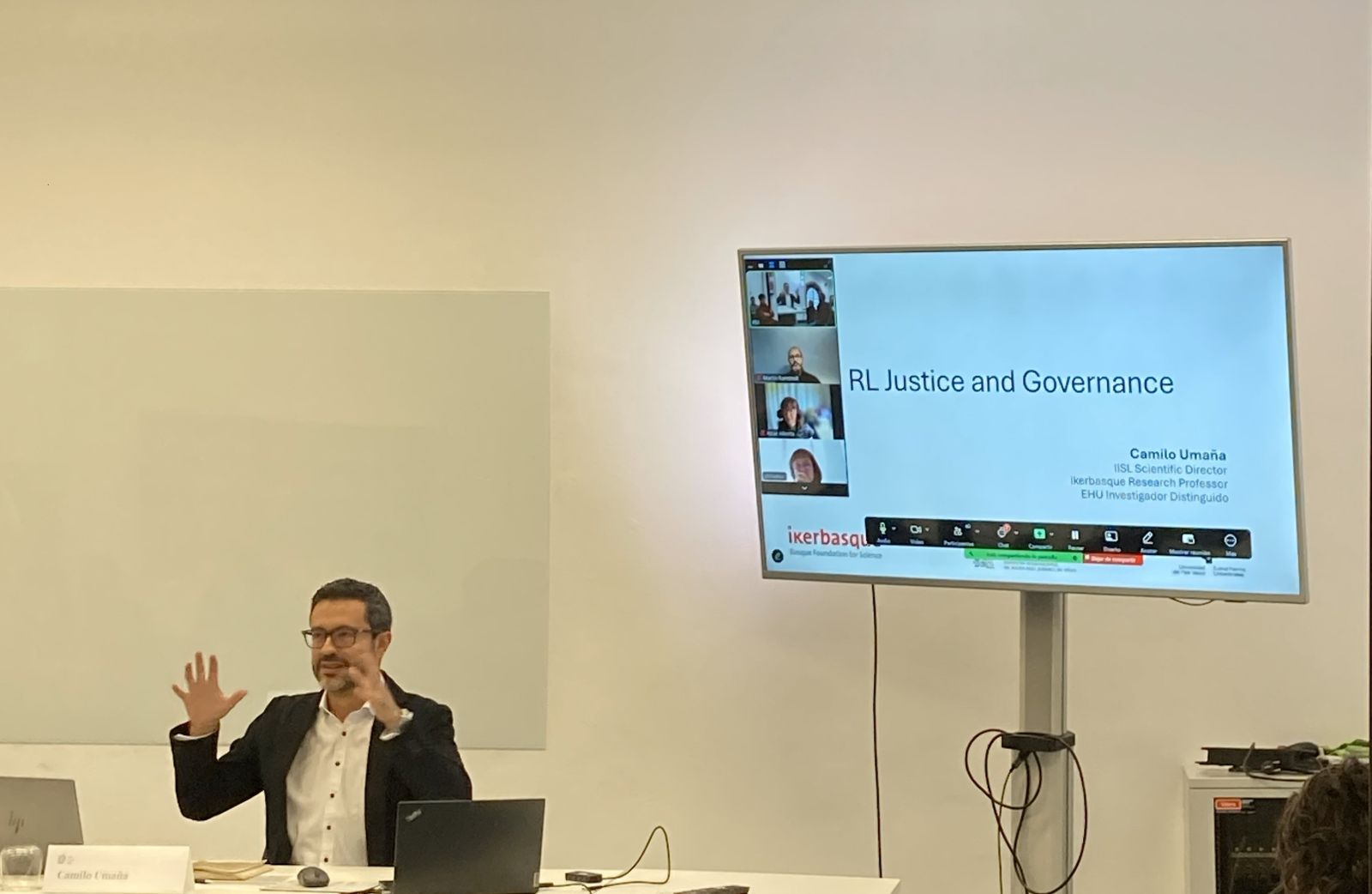
This Research line will investigate the transformations and innovations that justice systems are undergoing at the global, regional, national, and local levels, as well as the main problems and challenges that exist in accessing justice.
During 2026, this line of research will focus on diagnosing obstacles to access to justice and the functioning of the justice system in the Basque Country. To this end, a call for researchers will be launched who can carry out the research under the scientific coordination of the Scientific Director of the IISL.
The projects to be developed will be published in the first quarter of 2026 and will be as follows:
Project 1. Manual on Alternative Dispute Resolution (ADR)
- The Organic Law 1 of January 2, 2025, establishes that, in civil and commercial matters, as a rule, prior recourse to an ADR mechanism is a procedural requirement for a claim to be admissible.
The Institute of Legal Research (IISJ) will lead the development of a Manual analyzing the current state of Alternative Dispute Resolution (ADR) means in the Basque Country. This Manual will include a conceptual definition, a diagnosis of the current state of these mechanisms, and a mapping of existing resources to identify regulatory, institutional, and operational gaps. It will be based on the 2022–2028 Strategic Justice Plan, which proposes collaboration in structuring mechanisms to promote the use of ADR by citizens and in public policies.
Project 2. Evaluating the Educating in Justice program
- This program aims to enable Basque students to acquire knowledge of the justice system in order to strengthen the relationship between the judicial and educational systems.
On the one hand, P3 seeks to analyze the school’s curriculum content of compulsory education in order to identify and implement improvements. This will enable Basque students to acquire key knowledge, values, attitudes, and behaviors relevant for upholding the rule of law and understanding how the justice system functions.
On the other hand, P4 aims to ensure that Basque universities offering degrees related to law and justice have updated curricula that are appropriate to the needs of the sector and that incorporate real-world experience within the justice system.
The IISJ will lead two technical reports analyzing the current situation and proposing improvements for projects P3 and P4. This undertaking will benefit from a socio-legal perspective, recognizing legal education as a tool for democratizing knowledge and building critical citizenship.
Project 3. Diagnostic Report on the Current Situation of Access to Justice, Especially in Relation to Vulnerable Groups
Prepare four reports with diagnoses and proposals regarding inequalities in access to justice or in the provision of justice services in the Basque Country for vulnerable groups: women (P12), minors (P13), the elderly (P15), and migrants (P16) .
- Characterize the vulnerable population under study
- Characterize general obstacles that directly impact the justice system (exogenous vulnerabilities)
- Diagnose specific endogenous obstacles to accessing justice with respect to the following services 1) Legal aid and 2) Victim support
- Describe and analyze obstacles (structural, organizational)
- Describe and propose best practices and opportunities for improvement
Camilo Umaña
IISL (Scientific Director)
Avenida de la Universidad, 8
Apartado 28
20560 Oñati (Gipuzkoa) - Spain
T: +34 943 78... Ver teléfono
E: c.umana@iisj.es
 @IISJOnati


